

 Year one
Trimesters 1–3
35% hands-on
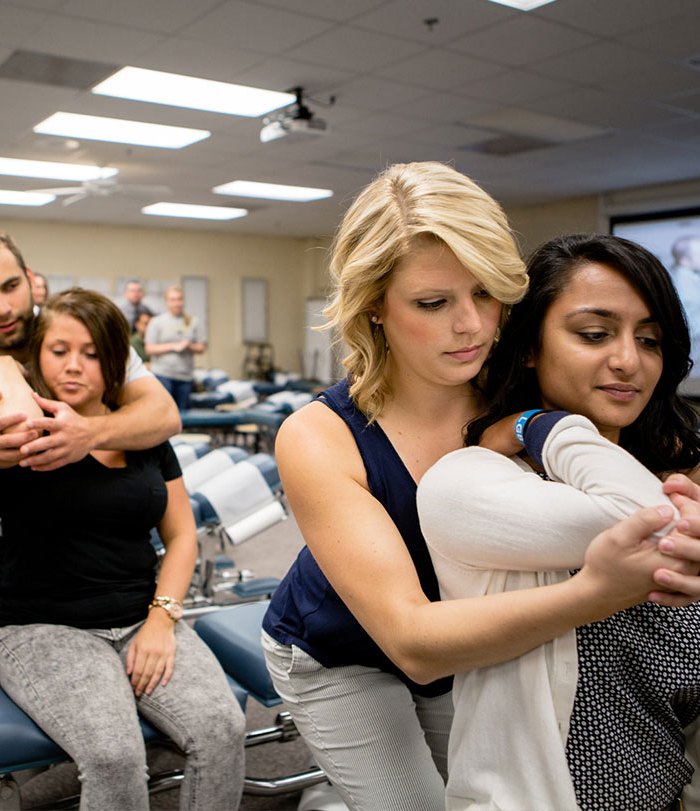
Build your foundation in anatomy, biochemistry and physiology — with faculty-guided methods labs from your very first trimester. Your hands are on people from the start.
Train with Depth. Graduate with Confidence.
You came here to take care of people. Logan gets you to your first patient faster than almost any chiropractic program in the country — clinical skills courses start your very first trimester, and they fill 40% of your first year.
By graduation you'll be fluent in four core chiropractic techniques and trained in up to eleven more. Fifteen in all. That's more than any other DC program in the U.S., and the ones you choose shape the practice you build.
Ten Trimesters.
About three years and four months from your first anatomy lab to carrying your own caseload. Full-time or part-time — your call.
IN-PERSON CLASSES
Hands-On Instruction
3 Years, 4 Months
Program Length
$15,070 Per Trimester
Flat Rate For 12+ Credit Hours
NEXT START DATE
January 11, 2027
Wherever you're starting from, there's a way in.
Ready to see if you qualify? Everything you need is on Admission Requirements.
Hands-on from day one
Clinical skills courses start in your very first trimester.
Technique mastery
Learn 15 evidence-informed techniques — the most in the U.S.
Chiro Connection
Speak with a practicing chiropractor through our mentor program.
Integrated success
Verbal, written and clinical reasoning skills for modern integrative health.
Ten trimesters, and every year you spend more of your time with patients and less of it in a lecture hall.
Year one35% hands-on
Build your foundation in anatomy, biochemistry and physiology — with faculty-guided methods labs from your very first trimester. Your hands are on people from the start.
 Year two
32% hands-on
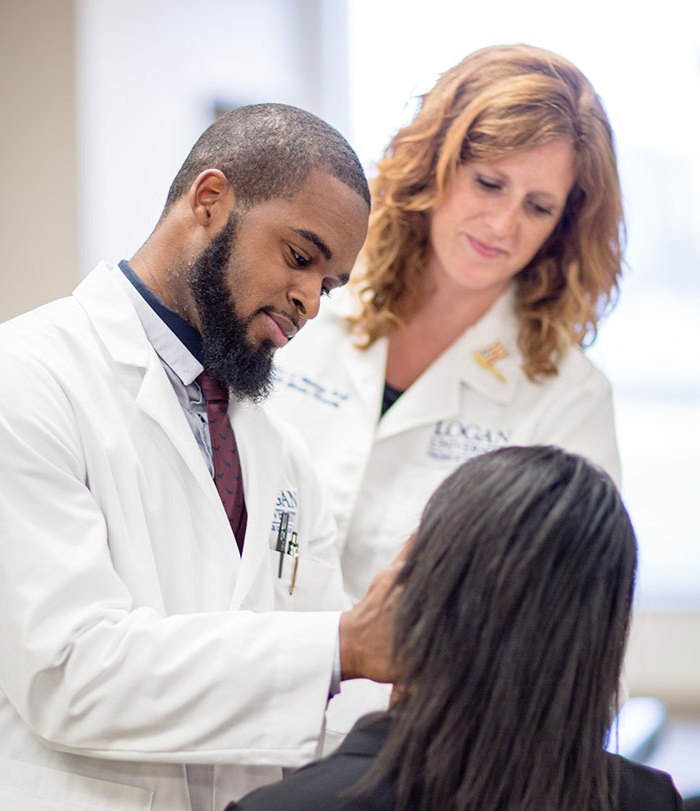
Go deeper into clinical diagnostics across neurological and internal disorders. You'll add the finance and ethics coursework that owning a practice actually takes.
 Year three
68% patient care
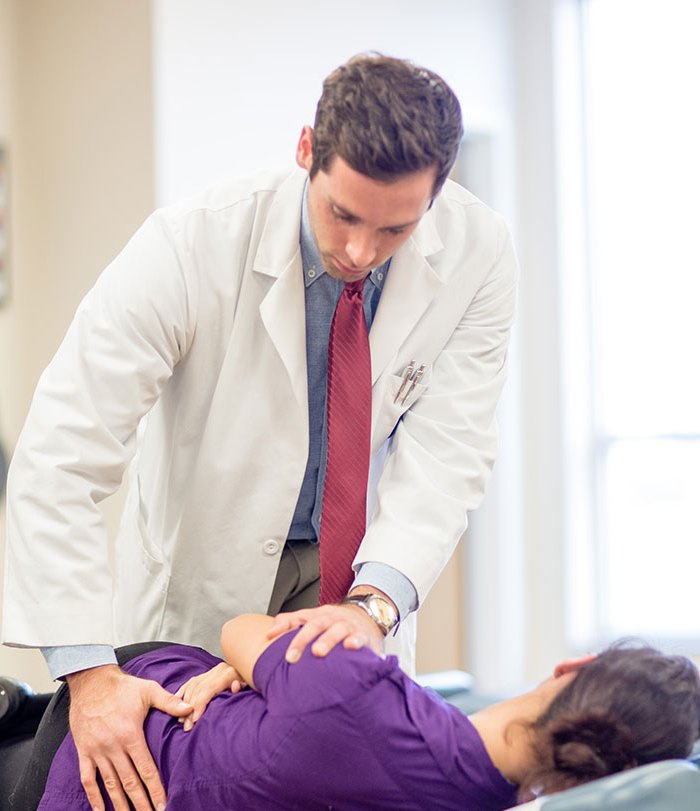
Rotations and clinical management. You carry your own caseload, and you graduate ready to practice — not ready to start learning.
Your final trimester completes the Doctor of Chiropractic program.
Dual enrollment lets you finish a master's alongside your DC — Nutrition & Human Performance, Sports Science & Rehabilitation, Strength & Conditioning, or Health Informatics. Same graduation date, two credentials.
Finish the MS-SSR sports and emergency-care lab and you're eligible to test for Certified Chiropractic Sports Physician certification from the American Chiropractic Board of Sports Physicians.
Four core techniques every Logan graduate carries into practice, plus eleven electives you choose from. Fifteen in all — more than any other DC program in the country.
This is where you specialize. The electives you pick shape the practice you build and the patients you're equipped to treat, whether that's athletes, families, older adults, or a general practice that sees all of them.
Select a vertebra to read what each technique teaches.
NOTE: In addition to the 15 techniques, our program provides 12 elective courses
Hands-on from day one
40% of your first year is spent in clinical skills courses, so you build clinical confidence long before graduation.
Trimester 7 is the one students remember.
That's the Health Center Induction Ceremony — the day you walk into the Montgomery Health Center and start treating real patients under faculty clinicians. By Trimester 8 you move into Logan's outpatient health centers and spend a full year treating the public.
In Trimesters 9 and 10, you can step outside the campus system entirely through the External Clinical Rotation Program. Private practice, hospital, VA facility — you pick the setting that matches where you want to end up.
Where You Practice
You learn technique on the equipment you'll use in practice.
Flat-bench and Activator tables are in the campus modular classrooms; Diversified tables are in Mabee Halls at the Purser Center and in the Administration Building. The Anatomy Lab and Lecture Amphitheater support technique instruction throughout the program.
The fifteen techniques are how you adjust. These are the clinical skills and certifications you layer on top, shaped around the patients you want to serve.
Acupuncture — Logan's Basic 100-Hour Acupuncture Certification Course covers Traditional Chinese Medicine theory, meridian systems and modern clinical application through lecture, demonstration and supervised hands-on training.
Dry Needling — Thin needles into myofascial trigger points to improve blood flow, reduce pain and restore range of motion in restricted muscles.
Selective Functional Movement Assessment (SFMA) — A movement-based diagnostic system for identifying the source of musculoskeletal pain. Evaluates seven fundamental movement patterns and separates mobility problems from motor-control problems.
Advanced Sport Concussion Management — Evidence-based diagnosis and treatment of concussion in physically active populations.
Pediatric Management — Extends the infant physical examination to spinal and cranial evaluation, tethered oral tissue assessment and primitive reflex testing. Builds the psychomotor skills for spinal adjusting, cranial maneuvers, soft tissue and fascial release, and viscerosomatic methods.
Clinical Care for the Pediatric Athlete · Occupational Consulting · Telehealth · The Healthcare Provider as an Educator · Pediatric Nutrition · Minor Surgery · Introduction to Sports Medicine · Evaluation and Management of Military & Veterans · Female Health and Wellness
Special technique course fees apply to ART ($850) and SFMA ($348) — see Tuition & Aid.
You won't face your boards alone. Preparation is built into the curriculum, most exams are proctored right here on campus, and your Success Coach maps the licensure requirements for the state where you plan to practice.
Logan's DC program meets the educational requirements for licensure in all 50 states, the District of Columbia and Puerto Rico.
You're betting on yourself. Here's how that bet has gone for the students who came before you.
Our students finish what they start. 84% complete the degree within two years of the standard timeline — comfortably above the 70% benchmark the Council on Chiropractic Education sets.
And they pass. 86% of our last four graduating classes passed every board part or were licensed within six months of graduating. That's 785 graduates out of 918, against an 80% benchmark.
Then they go to work. 91% of our Spring 2022 graduates were working in the field within nine months.
The U.S. Bureau of Labor Statistics projects chiropractor employment to grow 10% from 2024 to 2034 — much faster than the average for all occupations. More people are looking for natural, drug-free, whole-person care every year, and they need someone qualified to give it to them.
$15,070
Trimester flat-rate tuition
12 or more credit hours; underload is $1,257 per credit hour
Tuition rates are in effect for the fall, spring and summer trimesters, and new rates are set each year beginning with the fall trimester. Amounts below come from the Logan University academic catalog and are estimates; the Finance Office provides official tuition and fee amounts.
* Additional fees for these elective courses.
$15,070 per trimester. It's a flat rate capped at 12 credit hours — so if you carry 15 or 18, you pay the same as 12. Take the heavier load and it costs you nothing extra. Below 12 credit hours you're billed $1,257 per credit hour.
NBCE board exam costs are paid directly to the NBCE as each part comes due, and they're added to that trimester's cost of attendance — so you can borrow additional loan funds to cover them. Current fees are at nbce.org.
Money should not be the reason you don't do this.
You'll typically get your aid offer about two months before classes start, once your documents are in. Half-time enrollment is a minimum of six credit hours per trimester.
If you borrow a new federal Direct Loan on or after July 1, 2026, two repayment plans will be available to you, including Tiered Standard Repayment with terms of 10 to 25 years. Out-of-state grants have previously been available to DC students from Arkansas, Oklahoma and Mississippi — worth checking with your home state. On-campus work-study is available if you have financial need. Your aid status, awards and documents all live in NetPartner.
Logan's Federal School Code is 004703. As a graduate or professional student you're independent for FAFSA purposes — no parental information required. Excess credit balance refunds go out by direct deposit through Student Accounts.
Questions? The Office of Financial Aid is here: 877-408-6956 · FinancialAid@logan.edu
Logan funds 50% of any unmet tuition and fee charges for qualified applicants, up to a maximum contracted amount of $10,000. What you receive varies with the cost of your program and any tuition-specific scholarships already awarded, and a Yellow Ribbon award can't be combined with other Logan awards to create a tuition surplus.
To qualify you must be a degree-seeking student with net tuition and fee charges above the VA's annual maximum rate, be eligible for Chapter 33 Post-9/11 GI Bill benefits at the 100% level, maintain good academic standing, and file proof of eligibility with Logan's certifying official. Awards renew each year the program agreement renews. Logan may reduce or discontinue awards at the end of an academic year, and contributions aren't adjusted after the last day to drop without a W. Veterans submit a benefit registration form every trimester; transferring students file a change of program or place of training form.
Logan offers three ways in, so your transcript decides your pathway rather than closing a door. You'll also need a transcript from a USDE- or CHEA-recognized institution and a signed Acknowledgement of Technical Standards. Send transcripts electronically to document.admissions@logan.edu or by mail.
Not sure which pathway fits? Call us at 636-230-1750 or email Admissions@logan.edu and let's talk it through.
How to Apply
Next start: January 11, 2027. Cohorts begin every September, January and April/May.
Hear from some of our professors in the Chiropractic College that you will be taught by.
Farzana Karim, PhD
Assistant Professor
Professor Karim teaches the basic sciences with the clinic in mind, framing anatomy and physiology around the patients you'll treat from trimester one.
Weston Holzinger, DC, CS
Assistant Professor
Professor Holzinger is a practicing chiropractor who coaches your adjusting technique beside you in the skills labs.
Daryl Ridgeway, DC
Chair of the Clinical Sciences Division
Professor Ridgeway keeps coursework grounded in evidence and real patient care, from lecture through the health centers.
The Purpose of the College of Chiropractic is to prepare successful chiropractic primary care physicians to provide competent, comprehensive, patient-centered care with integrity.
Five Logan Learning Outcomes for Graduates
Accreditation.
Logan University is institutionally accredited by the Higher Learning Commission. The Doctor of Chiropractic program is awarded programmatic accreditation by the Council on Chiropractic Education.
 Higher Learning Commission230 S. LaSalle St., Ste. 7-500Chicago, IL 60604800-621-7440
 Council on Chiropractic Education10105 E. Via Linda, Suite 103–3642Scottsdale, AZ 85258-4321480-443-8877
The Council on Chiropractic Education requires an 80%+ four-year NBCE pass rate and a 70%+ two-year completion rate. Logan publishes both, in full. Logan's four-year NBCE result is 86% (785 of 918 graduates), and two-year degree completion is 84% (471 of 561 students). Source: Logan University Institutional Research.
Goal: The College of Chiropractic will achieve 80% or higher for the four (4) most recent years’ NBCE licensing exam rates in accordance with CCE Policy 56.
| Calendar Year (Last 4 years) | NUMBER OF GRADUATES IN CALENDAR YEAR | # PASSING LICENSING EXAM OR LICENSED TO PRACTICE WITHIN SIX MO. GRADUATION | % PASSING OR LICENSED WITHIN SIX MONTHS |
|---|---|---|---|
| 2022 | 238 | 202 | 85% |
| 2023 | 233 | 188 | 81% |
| 2024 | 216 | 195 | 90% |
| 2025 | 231 | 200 | 87% |
| Total | 918 | 785 | 86% |
Logan University is accredited by the Higher Learning Commission, which accredits degree-granting institutions across nineteen states. Institutional accreditation covers every Logan degree program, including this one.
Higher Learning Commission230 S. LaSalle St., Ste. 7-500Chicago, IL 60604800-621-7440Council on Chiropractic Education10105 E. Via Linda, Suite 103–3642Scottsdale, AZ 85258-4321480-443-8877Students and faculty on what clinical education at Logan actually feels like — from first trimester through graduation.